
5 Claude Secret Marketing Codes
The 5 real Claude skills built for marketing work, competitor ad breakdowns, AI search audits, content gap reports, lead magnets, and slop-free copy, why you'd actually want each one, and exactly how it works.
Save it, print it, read it offline. It's yours.
Most people only think to use Claude for writing captions or brainstorming ideas. There’s a whole layer of Skills built specifically for marketing work that most marketers have never installed, ones that pull real competitor data, audit how visible you are inside AI search, and catch the AI-sounding tells in your own copy before you post it.
Here are the 5 real skills, why you’d actually want each one, and exactly how it works.
Most competitor research happens by accident, you catch a competitor’s ad in your own feed, screenshot it, and move on. There’s no system to it, so you’re testing your own creative blind, guessing at what’s already working instead of knowing.
This skill fixes that by pulling real, currently-running ads straight from the Facebook Ad Library, LinkedIn, and the Google Ads Transparency Center for any competitor you point it at. It screenshots every ad it finds, then breaks each one down: the hook, the pain point, the offer, and the call to action, and groups them by theme, audience, and format.
Why you’d implement it: an ad that’s still running after weeks is an ad that’s still making money, platforms pull losing creative fast. So instead of spending your own budget testing five hook angles from scratch, you start from the angles a competitor has already proven out, and put your budget toward your own execution of it instead of the discovery phase.
Try this prompt once it’s installed:
Pull the ads [competitor name] is currently running on Facebook, LinkedIn, and Google. Break each one down by hook, pain point, offer, and CTA, then group them by theme and audience. Tell me which patterns show up across the most ads, that's the strongest signal of what's actually working for them.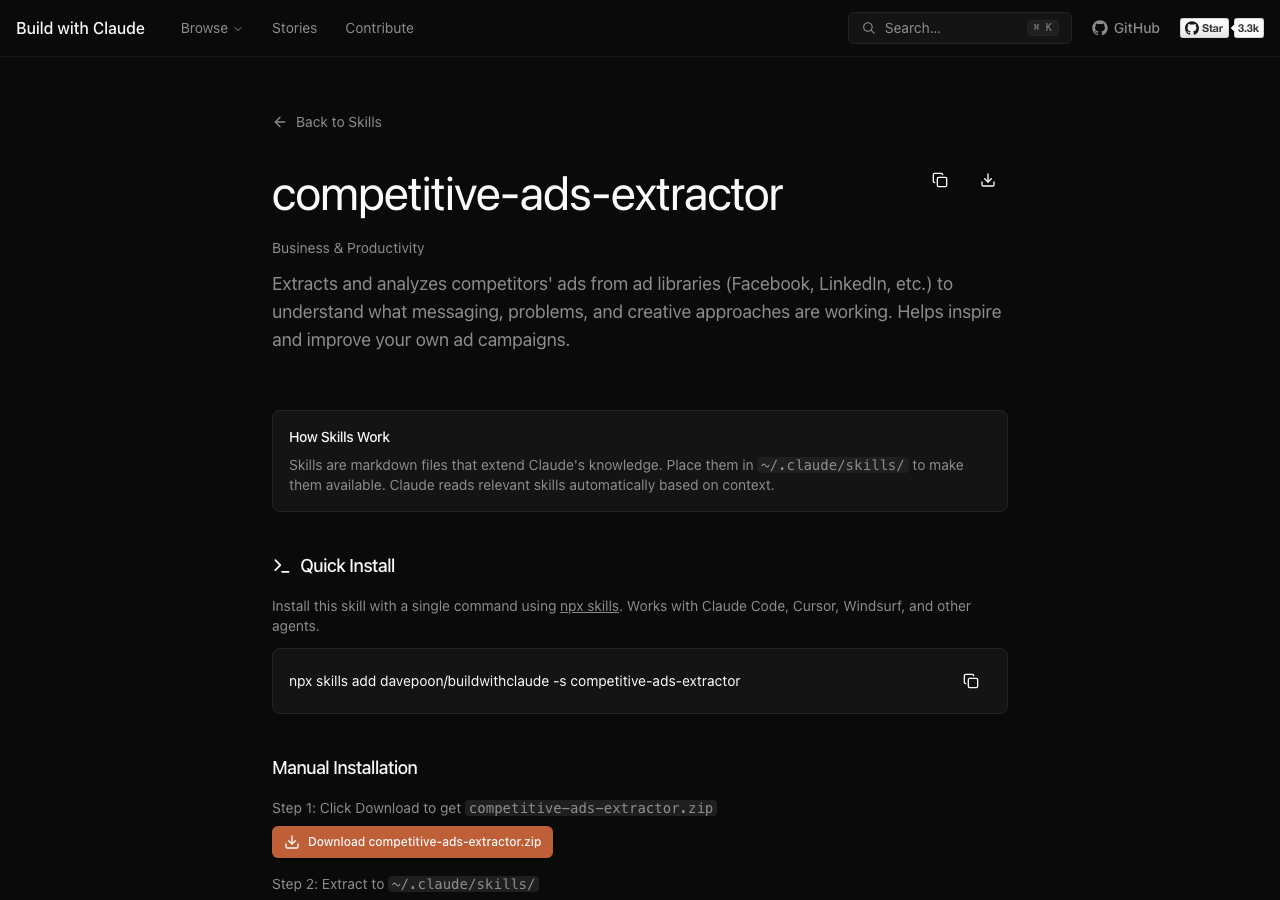
Where to get it: buildwithclaude.com/skill/competitive-ads-extractor
More of your audience is asking ChatGPT, Perplexity, and Google’s AI Overviews their questions instead of typing them into a search bar. A page can rank on page one of Google and still be completely invisible in those answers, because AI engines aren’t reading for keywords, they’re reading for a citable answer. Most marketers are still only optimizing for the search engine, not the AI one, which means an entire channel is going untouched.
This skill audits that gap directly. It runs your priority queries through ChatGPT, Perplexity, and Google AI Overviews, checks whether your competitors get cited where you don’t, and inspects your pages for the structural signals AI engines actually pull from: a clear definition near the top, self-contained answer blocks, cited stats, comparison tables, an FAQ section.
Why you’d implement it: this is still early. The brands showing up inside AI answers right now are the ones who noticed the shift first, not necessarily the ones with the best content. Fixing the structural gaps this skill finds is a real way to get ahead of that curve instead of catching up to it later.
Try this prompt once it’s installed:
Here are 10 questions my ideal customer would actually ask ChatGPT, Perplexity, or a Google AI Overview: [list your 10 questions]. Check whether my site [yoursite.com] gets cited for any of them, and check whether these competitors do instead: [list competitors]. For anywhere I'm missing, tell me the exact structural fix, the definition, the answer block, the table, whatever it is.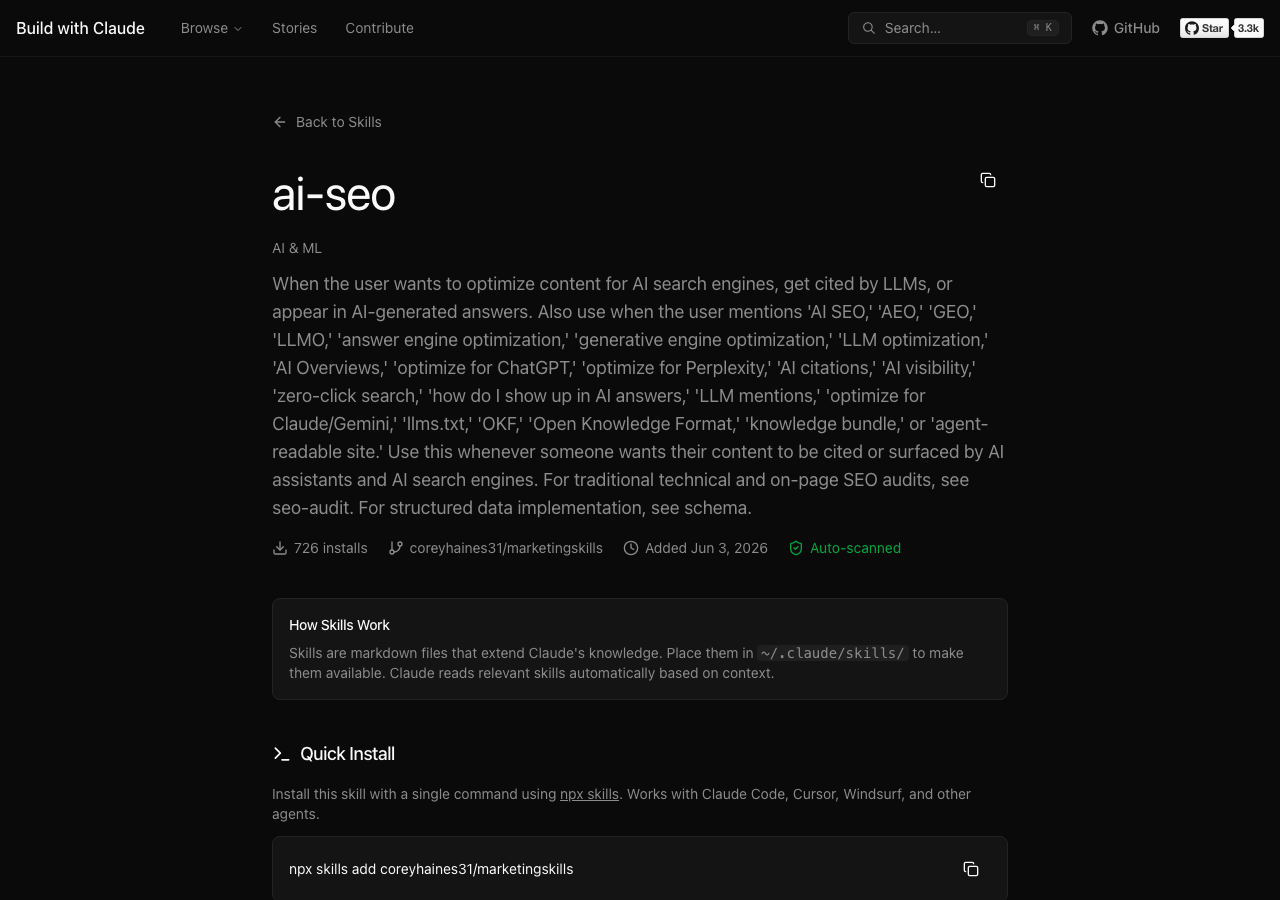
Where to get it: buildwithclaude.com/skill/ai-seo
The hardest part of a content calendar usually isn’t writing, it’s deciding what to write next. Most people fill that blank page from gut feel, which means it’s easy to miss an entire topic a competitor already owns, and just as easy to keep publishing on the same handful of topics because they’re the ones that come to mind.
This skill removes the guessing by auditing your content directly against your competitors’ and telling you exactly what they’ve covered that you haven’t. It sorts the gaps into three tiers, High Priority, Quick Wins, and Long-Term, and maps out entire topic clusters you’re missing, not just individual keywords, so it can flag a whole content format (a comparison guide, a tool, a video series) you don’t have at all.
Why you’d implement it: it turns “what should we post next” from a brainstorm into a ranked, evidence-backed list. That matters most when your time to actually create content is limited, every piece you make is one your competitor’s traffic already proved people want, instead of a guess you’re hoping lands.
Try this prompt once it’s installed:
Compare my site [yoursite.com] against these competitors: [list 2-3 competitor URLs]. Find the topics, keywords, and content formats they cover that I don't. Sort the gaps into High Priority, Quick Wins, and Long-Term, and give me the top 5 I should create first.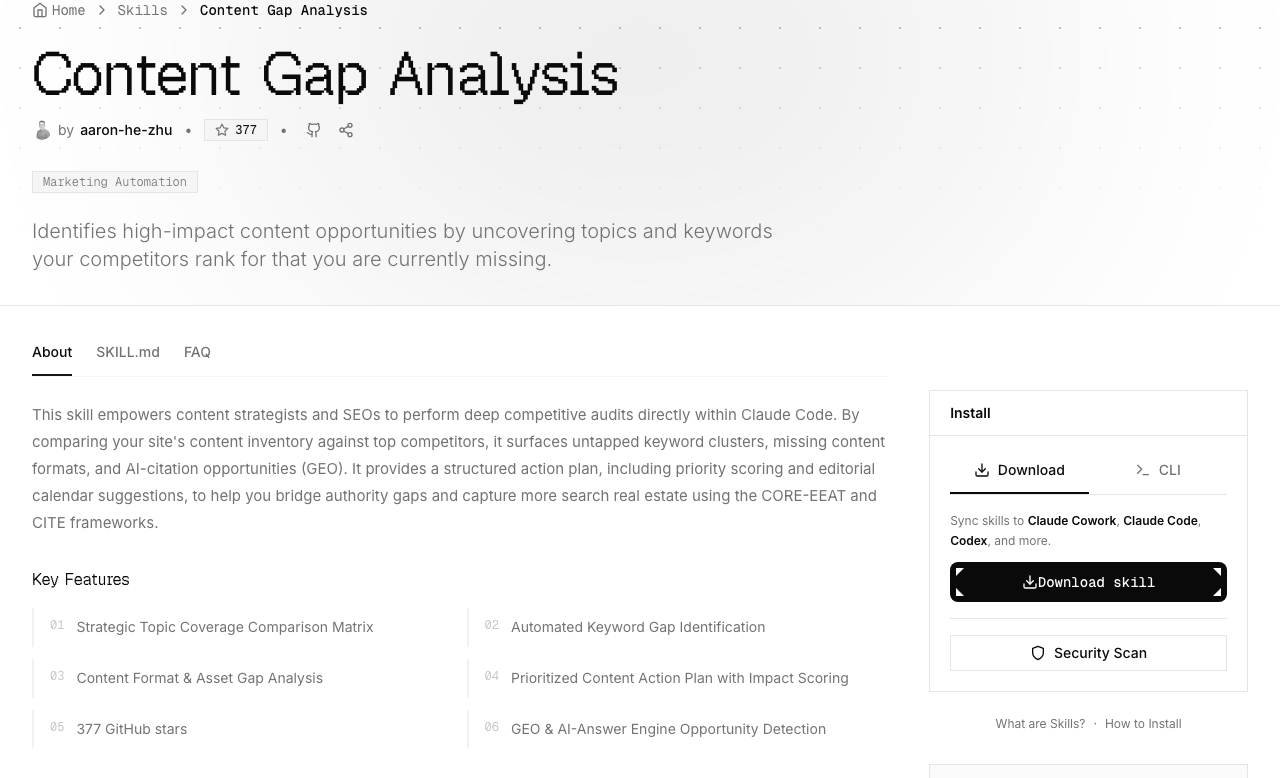
Where to get it: mcpmarket.com/tools/skills/content-gap-analysis
A generic “10 tips” PDF doesn’t convert, and most of the time the problem isn’t the idea, it’s that nobody builds the rest of the funnel around it. The lead magnet exists, but the landing page copy is thin and there’s no real follow-up email sequence behind it, so people opt in once and never hear from you again.
This skill builds the whole thing in one pass instead of just the PDF. It generates 5 real name options using a proven naming formula, picks the right structure for the offer (a checklist, a mini-guide, a swipe file, a toolkit), then writes the actual content, opening hook, core value, a bridge into your paid offer, and a close, plus the landing page copy and the follow-up email sequence to go with it. If you’ve defined your voice for Claude already, it writes all of it in that voice.
Why you’d implement it: “write me a lead magnet” gets you something generic every time, because a generic prompt has no shape to build from. This skill already knows the shape a lead magnet needs to actually convert, and it builds the funnel around it at the same time, the landing page and the emails, not just the freebie, which is usually the part that gets skipped.
Try this prompt once it’s installed:
Build me a lead magnet for [your audience, e.g. "small business owners who want to use AI"]. My offer is [what you actually sell]. Give me 5 name options, pick the best format, then write the full content, the landing page copy, and a 3-email follow-up sequence that leads into my offer.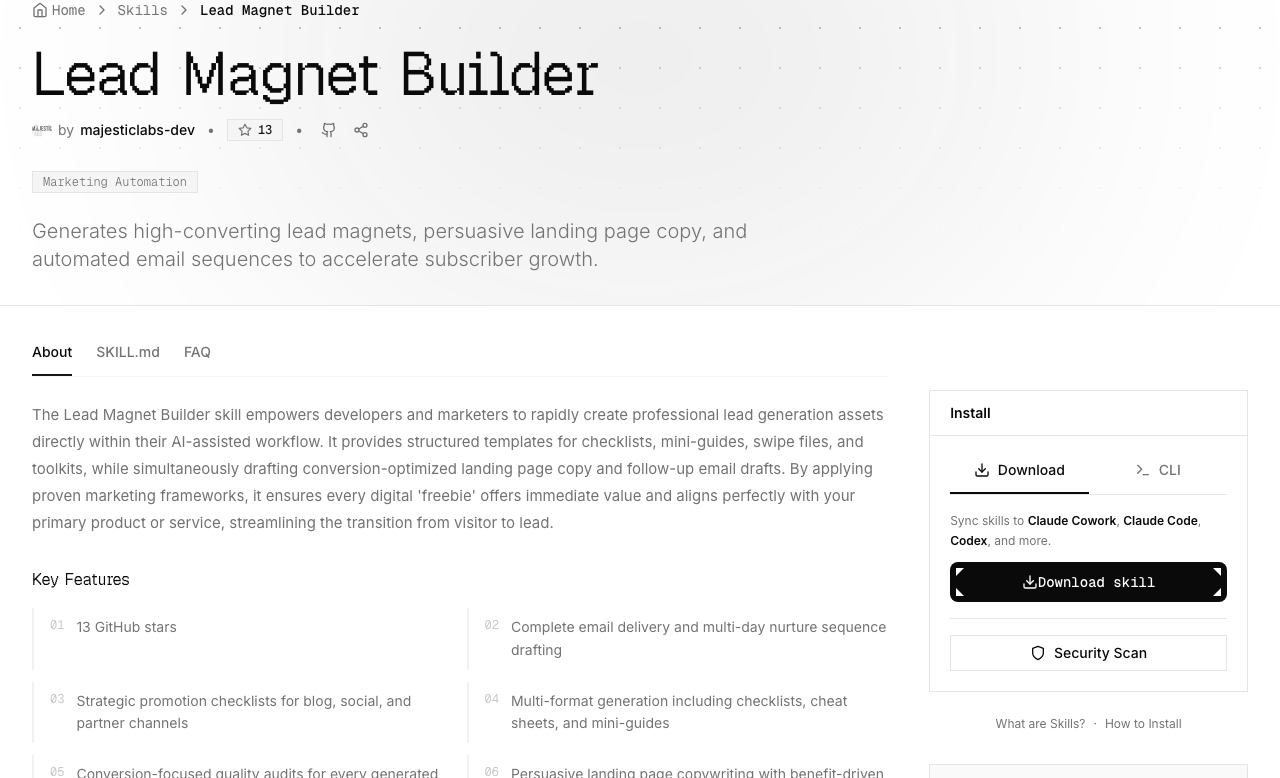
Where to get it: mcpmarket.com/tools/skills/lead-magnet-builder
AI-written marketing copy has developed real, recognizable tells, filler openers, hedge words, the same handful of phrases showing up everywhere. People can feel it even when they can’t name why, and that read costs you trust and conversion, even when the grammar is perfectly clean.
This skill finds those exact tells and cleans them out. It runs your draft against a defined set of rules, cut the filler openers (“here’s the thing,” “let that sink in,” “this matters because”), cut adverbs, cut passive voice, cut binary contrasts, be specific, then checklists the draft before you ship it.
Why you’d implement it: if you’re using Claude or ChatGPT to help write captions, emails, or ad copy, and most marketers now are, this is the pass that keeps that copy from reading like it came from a machine. It protects the one thing AI can’t fake on its own, a voice that actually sounds like a person wrote it.
Try this prompt once it’s installed:
Run this draft through your AI-slop rules and clean it up, cut filler openers, adverbs, passive voice, and binary contrasts, keep it specific: [paste your draft]. Show me what you changed and why, don't just hand back a rewrite.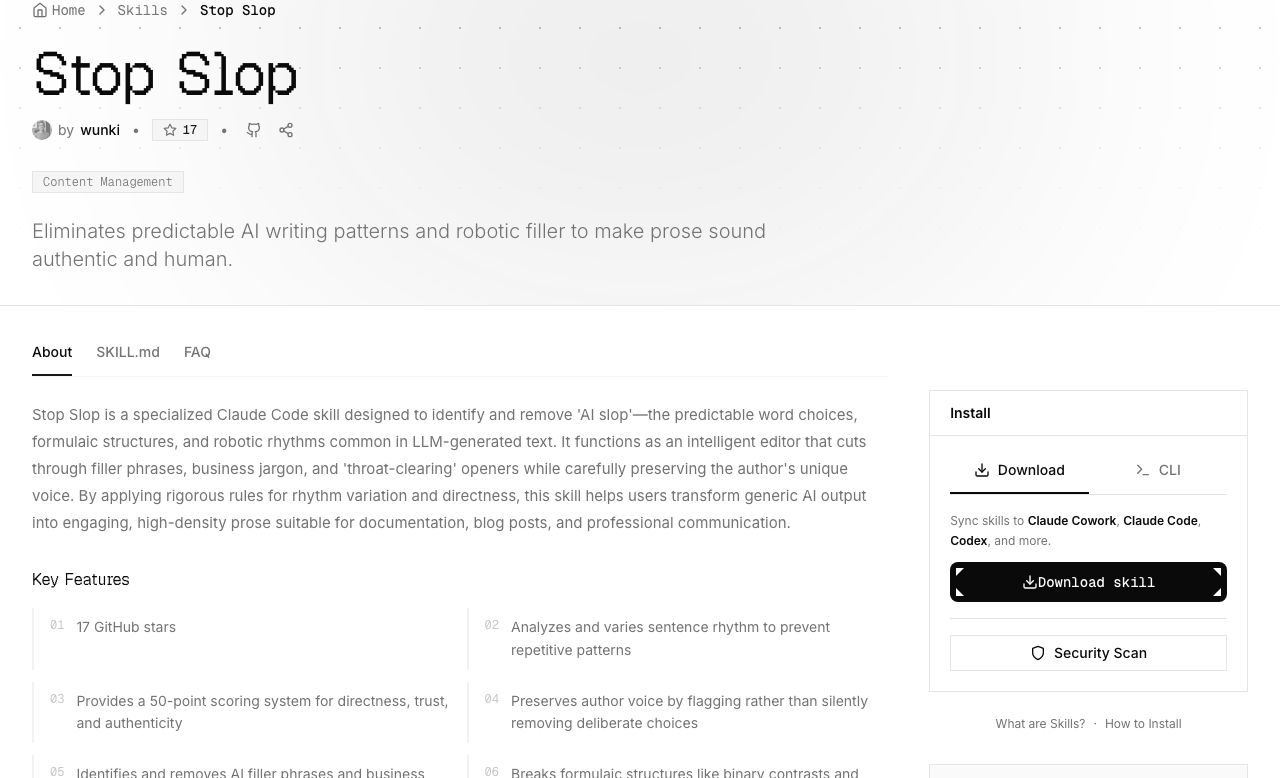
Where to get it: mcpmarket.com/tools/skills/stop-slop
A few things to watch for
- Competitive Ads Extractor and Content Gap Analysis pull from public data, ad libraries and public pages, so results are only as good as how visible your competitors already are there.
- These are real, actively maintained skills as of this guide’s publish date. The skill ecosystem moves fast, check the linked page itself if it’s been a while since you’re reading this.
- Once installed, a skill loads automatically when the work calls for it. You don’t have to re-explain what it does every time you use it.
The takeaway
Most marketers are still doing this work by hand, or not doing it at all because it takes too long to do by hand. These 5 skills turn competitor research, AI-search visibility, content planning, lead magnets, and copy editing into things Claude can actually do for you, not just talk about.
Want more like this?
One simple AI win in your inbox every Sunday. No jargon, no overwhelm, unsubscribe whenever you like.
Want more like this?
Free AI guides added regularly. No jargon, no overwhelm.
kellystrattonai.com