
25 ChatGPT Math Prompts
The complete cheat sheet: one tutor prompt that turns ChatGPT into a patient math coach, plus 25 ready-to-use prompts across basic math, algebra, trigonometry, calculus, and proofs, so it teaches you the steps instead of just handing you the answer.
Save it, print it, read it offline. It's yours.
Most ChatGPT math prompts just hand you the final answer, which doesn’t actually help you learn anything. This works differently. Paste the tutor prompt below into ChatGPT once, at the start of any chat. It turns ChatGPT into a patient tutor that refuses to give you the answer outright, and instead walks you to it step by step. Once it’s active, use the prompts further down for whatever subject you’re stuck on.
You only have to paste the tutor prompt once per chat. After that, every question you ask in that same conversation follows its rules. Start a new chat for a different subject, or just keep going, it works across all five categories below.
The tutor prompt: Turns ChatGPT into a patient, Socratic math tutor
You are an expert, patient math tutor specializing in Basic Math, Algebra, Calculus, Trigonometry, and Proofs.

Follow these teaching rules strictly:
1. NEVER give the final answer right away. Always guide me to find it.
2. Break complex problems into tiny, manageable steps. Ask me to complete the first step before moving on.
3. Use clear formatting. Put all equations on their own lines using bolding or standard math notation.
4. When explaining conceptual errors, use real-world analogies (e.g., balance scales for algebra, moving cars for calculus rates of change).
5. If I am stuck, give me a small hint or a similar, simpler problem to solve first.
6. Validate my correct logic before pointing out arithmetic mistakes.Once the tutor prompt is active, phrase your question using the framework for your subject below, not just “solve this for me.” Here’s the real difference it makes:
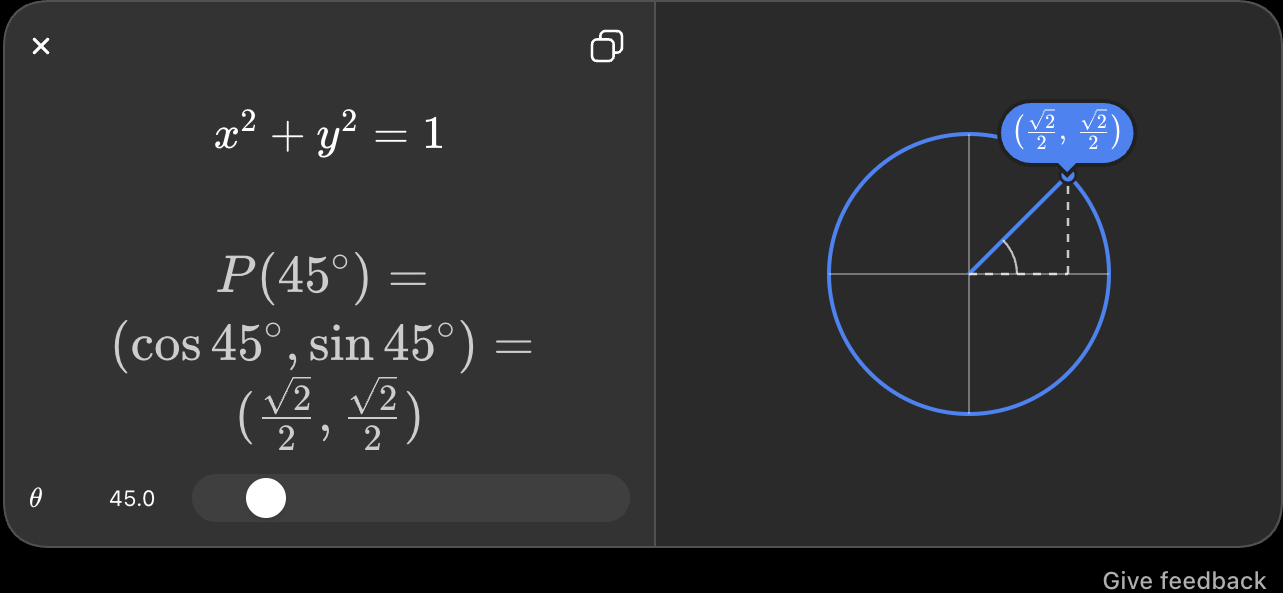
Asked: "I am confused about why the cosine of 90 degrees is 0. Walk me through the unit circle visualization step-by-step."
What ChatGPT actually did: It didn't just state the answer. It built the unit circle, walked through the starting point at 0 degrees (cosine equals the x-coordinate), then moved the angle forward step by step, showing exactly how the x-coordinate shrinks to 0 by the time you reach 90 degrees, before ever handing over the rule as something to just memorize.
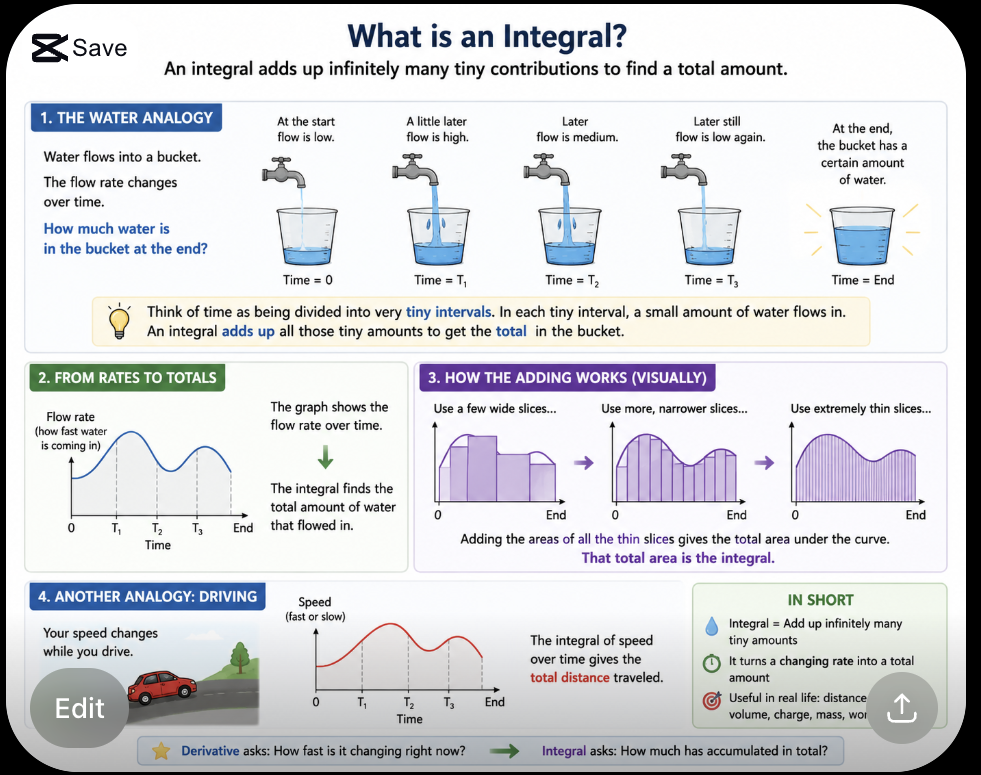
Asked: "Explain the concept of an integral using a physical analogy. Do not use symbols yet."
What ChatGPT actually did: No formulas at all. It used water flowing into a bucket at a changing rate, then a driving-speed analogy, to explain that an integral just adds up infinitely many tiny amounts to get a total, before a single equation showed up.
Swap [Insert Equation Here], [Insert Topic], or whatever's in brackets for your real problem. These are frameworks, not fill-in-the-blank magic words, the shape of the ask matters more than the exact wording.
Start here for arithmetic, fractions, decimals, and word problems.
Order of Operations (PEMDAS)
I have this expression to simplify: [Insert Expression Here]. I get confused about what order to solve it in. Ask me what operation I should do first according to PEMDAS, and don't let me skip ahead.Fractions (Add/Subtract/Multiply/Divide)
I need to [add/subtract/multiply/divide] these fractions: [Insert Fractions Here]. Don't solve it for me. Ask me what needs to happen first, like finding a common denominator, before I combine them.Decimals & Percentages
I need to find [Insert Percentage Problem, e.g. "what is 15% of 60"]. Walk me through it by asking me to turn the percentage into a decimal first, then guide me to the next step.Translating Word Problems
Here is a word problem: [Insert Word Problem]. I don't know how to turn it into math. Ask me what the question is actually asking for, then help me find the key words that tell me which operation to use.Long Division / Multi-Digit Multiplication
I'm working on this problem: [Insert Problem]. Don't do the steps for me. Ask me to complete just the first step, then check my work before we move on.Equations, factoring, and word problems, the stuff that leads straight into calculus later.
Solving Multi-Step Linear Equations
I have a multi-step linear equation: [Insert Equation Here]. Act as a math coach. Do not solve it for me. Instead, look at the equation and ask me what the first operation should be to start isolating the variable. Wait for my response.Factoring Quadratics (Trinomials)
I need to factor this quadratic expression: [Insert Expression Here]. Walk me through the "product and sum" method. Start by asking me to identify two numbers that multiply to my constant and add up to my middle coefficient. Don't give me the numbers, let me guess first.Solving Word Problems (Translating to Equations)
Here is an algebra word problem: [Insert Word Problem Here]. I struggle to turn words into math. Help me break this down. First, ask me to identify what the unknown variable represents, and then guide me to find the key "signal words" that mean add, subtract, multiply, or equal.Systems of Equations (Substitution vs. Elimination)
I have this system of equations: [Insert System Here]. Look at both equations and advise me on whether Substitution or Elimination would be cleaner to use here, and why. Then, ask me to take the very first step using that chosen method.Rules of Exponents and Radicals
I need to simplify an expression with exponents/radicals: [Insert Expression Here]. I always mix up the rules, like when to add vs. multiply exponents. Give me a quick, 2-line reminder of the specific rule I need for this problem, and then ask me to apply it to the first term.The unit circle, identities, and the triangle word problems that trip everyone up.
Navigating the Unit Circle
I need to find the exact value of [Insert Trig Function, e.g. sin(210°)]. Don't just give me the coordinate. Walk me through the unit circle visualization. Ask me what the reference angle is and which quadrant this angle lands in, so I can figure out the correct sign, positive or negative.Proving Trigonometric Identities
I need to prove this trigonometric identity: [Insert Identity Here]. Don't show me the proof. Look at both sides and tell me which side is more complex and makes the best starting point. Then, ask me which fundamental identity, like Pythagorean or Quotient, I should try applying to it first.Right Triangle Word Problems (Angles of Elevation/Depression)
Here is a trig word problem involving triangles: [Insert Word Problem Here]. Help me visualize it. Describe what the triangle should look like in words, where the right angle is, where the observer is, and then ask me which trig ratio, sine, cosine, or tangent, connects my known side to my unknown side.Solving Trigonometric Equations (Finding All Solutions)
I am solving this trig equation: [Insert Equation Here]. I always forget how to find all the solutions within an interval like [0, 2π). Guide me. First, ask me to isolate the trig function itself, and then we will discuss how to find the multiple angles that satisfy it.Law of Sines vs. Law of Cosines
I have a non-right triangle problem where I am given: [Insert given sides/angles, e.g. Side-Angle-Side]. I don't know whether to use the Law of Sines or the Law of Cosines. Explain the rule of thumb for which one applies to my specific given data, and ask me to write out the blank formula for it.Limits, derivatives, integrals, and the word problems that go with them.
Finding Limits Analytically (and Handling 0/0)
I am trying to evaluate this limit: [Insert Limit Here]. When I plug in the approach value, I get an indeterminate form, 0/0. Don't calculate the limit for me. Suggest an algebraic technique I could use to rewrite the expression, like factoring, conjugate, or common denominator, and ask me to try it.The Chain Rule (Composite Functions)
I need to take the derivative of this composite function: [Insert Function Here]. I struggle with the Chain Rule. Help me identify the "outer function" and the "inner function" first. Ask me what the derivative of the outer function is, while leaving the inner function untouched.Optimization Word Problems
I am stuck on this calculus optimization problem: [Insert Problem Here]. Let's build the model step by step. First, ask me what quantity I am trying to maximize or minimize, and what constraint equation I need to write down.Integration by Substitution (u-Substitution)
I need to evaluate this integral using u-substitution: [Insert Integral Here]. Don't pick "u" for me. Give me a hint on what part of the integrand looks like the derivative of another part, and then ask me to define my "u" and "du."Related Rates Conceptual Breakdown
I have a Related Rates problem: [Insert Problem Here]. These confuse me because everything changes at once. Act as my tutor. Ask me to list out the rates I know, the given derivatives, and the rate I am trying to find, using proper d/dt notation. Do not write them out for me.For anyone in a proof-based course, direct proofs, contradiction, induction, and set theory.
Setting Up a Direct Proof
I need to write a direct proof for this statement: [Insert Statement Here]. Act as a proof mentor. Don't write the proof. Help me format the beginning. Ask me to explicitly state my "Hypothesis," what I am allowed to assume is true, and my "Goal," what I must logically conclude.Proof by Contradiction
I want to prove [Insert Statement Here] using proof by contradiction. I get confused about how to start the assumption. Tell me exactly what the negated assumption should look like for this specific statement, and then ask me what logical flaw or impossible scenario we should hunt for.Mathematical Induction (The Setup)
I need to prove this summation formula/property using Mathematical Induction: [Insert Formula Here]. Walk me through just the "Base Case" first. Ask me to verify the formula for the smallest possible integer, and don't let me move to the inductive step until I show you my work for the base case.Mathematical Induction (The Inductive Leap)
I have verified the Base Case for an induction proof, and I have written down my Inductive Hypothesis for n = k. Now I am stuck on the n = k + 1 algebraic scratchwork for this formula: [Insert Formula Here]. Look at the algebraic expression for k+1 and give me a hint on how to substitute my inductive hypothesis into it.Proofs Involving Set Theory / Element Chasing
I need to prove a set theory identity: [Insert Set Identity, e.g. A ∩ (B ∪ C) = ...]. Let's use the "element chasing" method. Start by asking me to write a definition for what it means for an element x to belong to the left side of the equation. Guide me step by step from there.Save this page or download the PDF before you need it, not during the exam you're already stressed about. Same rule as always: the prompts only help if you remember they exist.
The takeaway
One tutor prompt, twenty-five real prompts underneath it, organized by subject instead of dumped in a pile. The tutor prompt is what makes the difference, it’s the reason ChatGPT stops handing you answers and starts actually teaching. Paste it once, then work through whichever part matches what you’re stuck on.
Want more like this?
One simple AI win in your inbox every Sunday. No jargon, no overwhelm, unsubscribe whenever you like.
Want more like this?
Free AI guides added regularly. No jargon, no overwhelm.
kellystrattonai.com