
The Beginner's Guide to AI SEO
Your rankings are fine and your traffic is gone. Here's where AI actually gets its answers, the seven moves that put you in them, and how to check if any of it worked. Plain English, one afternoon.
Save it, print it, read it offline. It's yours.
If you’ve been paying someone for SEO, or doing it yourself, and the traffic quietly stopped showing up anyway, you’re not imagining it and you didn’t do anything wrong. The thing you were optimizing for changed underneath you.
This is the whole shift in plain English, plus the seven things actually worth doing about it. No code. Nothing you need to hire out. You can get through all of it in an afternoon.
Nothing here asks you to abandon SEO. Google's own 2026 guidance says optimizing for AI search is still SEO. What changed is the finish line. You used to be trying to get clicked. Now you're trying to get quoted. Most of the work is the same, and the small part that's different is what this guide is about.
What actually changed
Three numbers explain the whole thing.
About 68% of US Google searches now end without a single click. That’s from SparkToro and Similarweb clickstream data covering January through April 2026. Up from 60.45% in 2024. Seven out of ten people search, read, and leave.
AI Overviews passed 2.5 billion monthly users. That’s Sundar Pichai’s own number. The AI summary at the top of the page isn’t a feature anymore. For most people it’s just what search looks like.
And when that summary shows up, clicks collapse. Roughly 8% of those searches produce a click, against about 15% when no summary appears. Nearly half your clicks, gone, on any query where Google decides to answer for you.
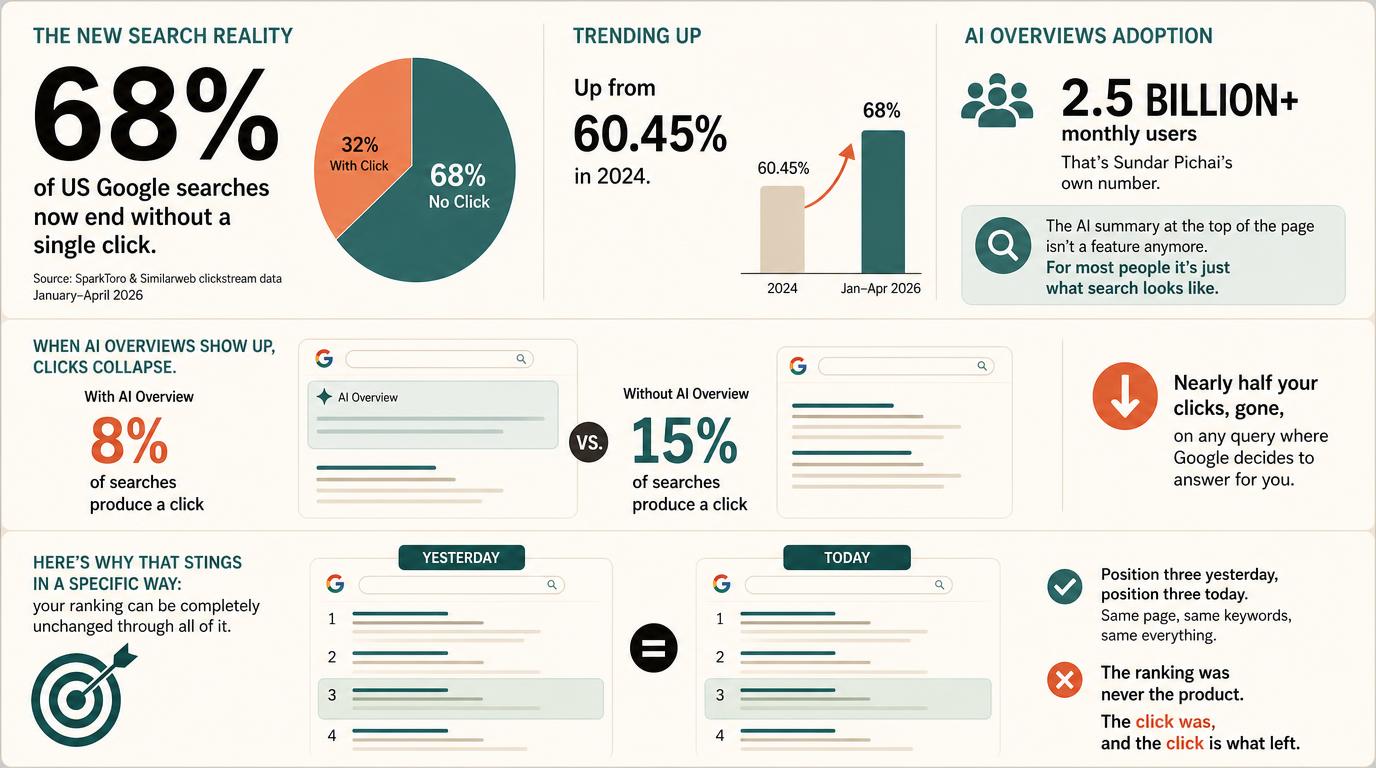
Here’s why that stings in a specific way: your ranking can be completely unchanged through all of it. Position three yesterday, position three today. Same page, same keywords, same everything. The ranking was never the product. The click was, and the click is what left.
The one idea that makes the rest make sense
AI doesn’t invent information. It digests it.
When someone asks ChatGPT for the best plumber in Charlotte, or which accounting software fits a two-person shop, it isn’t reasoning from first principles. It’s pulling from text that already exists somewhere and assembling an answer out of it.
Which means somebody is already the answer for what you sell. Some page, some thread, some review roundup is already being quoted when your ideal customer asks. It just isn’t you yet.
That’s the entire job now. Not climbing a list. Being in the material.
This is the part almost nobody tells you, and it’s the part that makes the rest obvious. When you look at where AI citations actually come from across ChatGPT, Perplexity, Google, and Claude, the split looks nothing like a Google results page.
Across the studies published in 2026, citation slots break down roughly like this:
| Source type | Share of citations |
|---|---|
| Editorial reviews (Wirecutter, NerdWallet, G2, Healthline, Investopedia) | 22.3% |
| Vendor and brand sites | 14.7% |
| 11.4% | |
| News and press | 9.1% |
| Wikipedia | 8.9% |
| Other forums and Q&A | 7.8% |
| Academic and government | 6.5% |
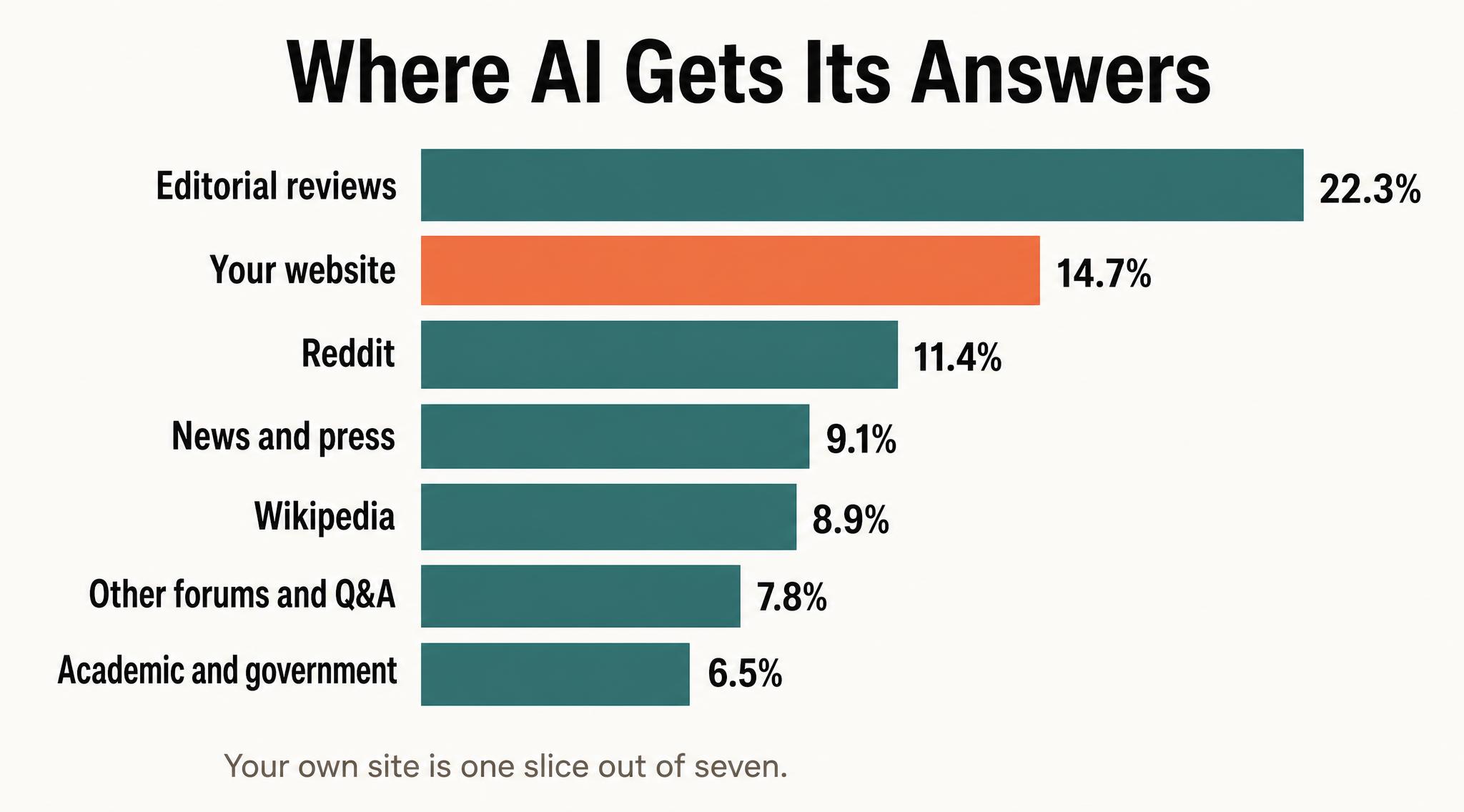
Three things fall out of that table.
Your own website is a minority shareholder. Vendor sites are 14.7% of citations. Everything else is other people’s pages talking about you. If your whole strategy is your own site, you’re competing for one slice out of seven.
Reddit is enormous and almost nobody plans for it. Reddit alone appears in 92.8% of AI search opportunities. It’s 21% of Google AI Overview citations and 46.7% of Perplexity’s. Perplexity cites Reddit roughly three times more often than ChatGPT does.
The engines don’t agree with each other. Brand and vendor sources are 59.8% of Google AI Overview citations, 44.7% of ChatGPT’s, and only 28.9% of Perplexity’s. So the same business can be highly visible in one and invisible in another. If you check one AI and conclude you’re fine, you checked one seventh of the picture.
Do them in this order. The first three are free and take an afternoon. The last two are slower.
Move 1: Answer the question in the first 200 words
AI systems that fetch pages in real time judge relevance mostly on your opening. If the answer to the question is in paragraph nine, underneath your founding story and a stock photo, it may as well not be on the page.
Open with the answer. Then explain it. Then add the story if you still want it.
Buried: "Founded in 2011, our family-owned practice has served the greater Charlotte area with a commitment to excellence and personalized care..." Nine paragraphs later: what a crown costs.
Answer first: "A dental crown in Charlotte runs $900 to $1,800 depending on the material. Porcelain sits at the top of that range, metal at the bottom. Most insurance covers about half." Then the story.
This is also just better for humans, which is the tell that it’s a real change and not a trick.
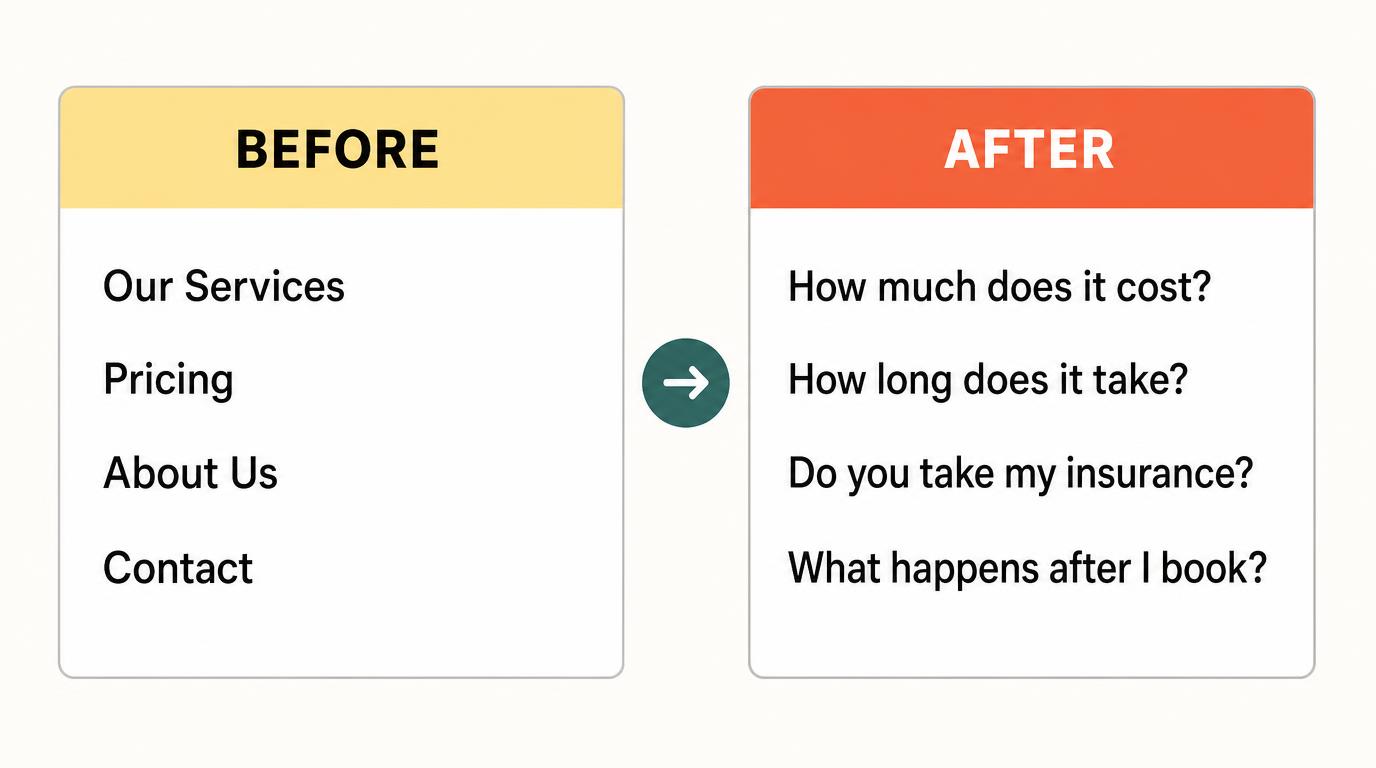
Move 2: Turn your headings into the questions people actually ask
This is called out repeatedly as the highest-return single change available. Not “Our Services.” Not “Pricing.” The literal question, phrased the way a person types or says it.
“How much does a crown cost?” beats “Pricing.” “Do you take Delta Dental?” beats “Insurance.” “How long does it take?” beats “Process.”
Write the ten questions people email or ask you on the phone every week. Those are your headings. You already know them by heart, which is why nobody writes them down.
Move 3: Get into the sources AI already trusts
You can’t add yourself to Wirecutter. You can do these.
Be genuinely useful in the communities where your customers already ask. Reddit is 11.4% of all citations and shows up in 92.8% of AI search opportunities. Find the subreddit where people ask about what you do and answer questions properly, as yourself, without pitching. This is slow and it compounds, and it is the single most under-used move on this list.
Claim and fill out every review and directory profile you already have. These feed the editorial and aggregator sources that make up the biggest citation slice.
Get mentioned in one real piece of local or trade coverage. One genuine article outperforms a year of press releases.
Do not go seed Reddit threads about your own business. It reads as astroturf to humans and to the platform, it gets removed, and it can follow you. Answer questions in your area of actual expertise and let your name be attached to good answers. That's the whole play, and it works because it's real.
Move 4: Add the two pieces of schema every site needs
Schema is a small block of code that labels your business for machines. It doesn’t change how your page looks to a human at all.
It matters more than it used to: 65% of pages cited by Google AI Mode and 71% of pages cited by ChatGPT include structured data. That’s a correlation, not a guarantee, but it’s a big one.
You need two, and only two, to start.
Organization schema. Your name, your logo, your website, your social profiles. LocalBusiness schema. The same plus your address, hours, and service area, if you serve a physical place.
Every major platform has this built in or one plugin away. WordPress: Yoast or RankMath. Shopify, Squarespace, and Wix generate the basics automatically once you fill in your business details in settings, which most people never finish.
Here’s a prompt that writes it for you. Paste your details in and paste the result where your site takes custom code in the head section.
Write valid JSON-LD Organization and LocalBusiness schema for my business.

Business name:
Website:
Address:
Phone:
Hours:
What we do, in one sentence:
Social profile URLs:

Return only the code block, ready to paste into the head of my site. Use schema.org
vocabulary. Do not include any fields I did not give you a value for.
Move 5: Add an llms.txt file
One plain text file that tells AI systems what your site is and which pages matter. It takes about fifteen minutes and no coding.
This is the one piece of this guide that already has its own walkthrough, including the exact steps for WordPress, Wix, Squarespace, and Shopify.
Get the full llms.txt walkthrough →
Move 6: Don’t abandon your rankings
The most common overreaction to all of this is deciding SEO is dead and stopping. The data says the opposite.
A page ranking first has about a 58% chance of being cited in an AI Overview. By position ten, that’s 14%. Ranking is no longer the destination, but it’s still the strongest single predictor of getting quoted. You’re not replacing SEO. You’re adding a floor above it.
Move 7: Start counting prompts, not keywords
Keyword search volume is being replaced by something people are calling prompt volume: how often someone asks an AI about a topic, rather than how often they type it into a search box.
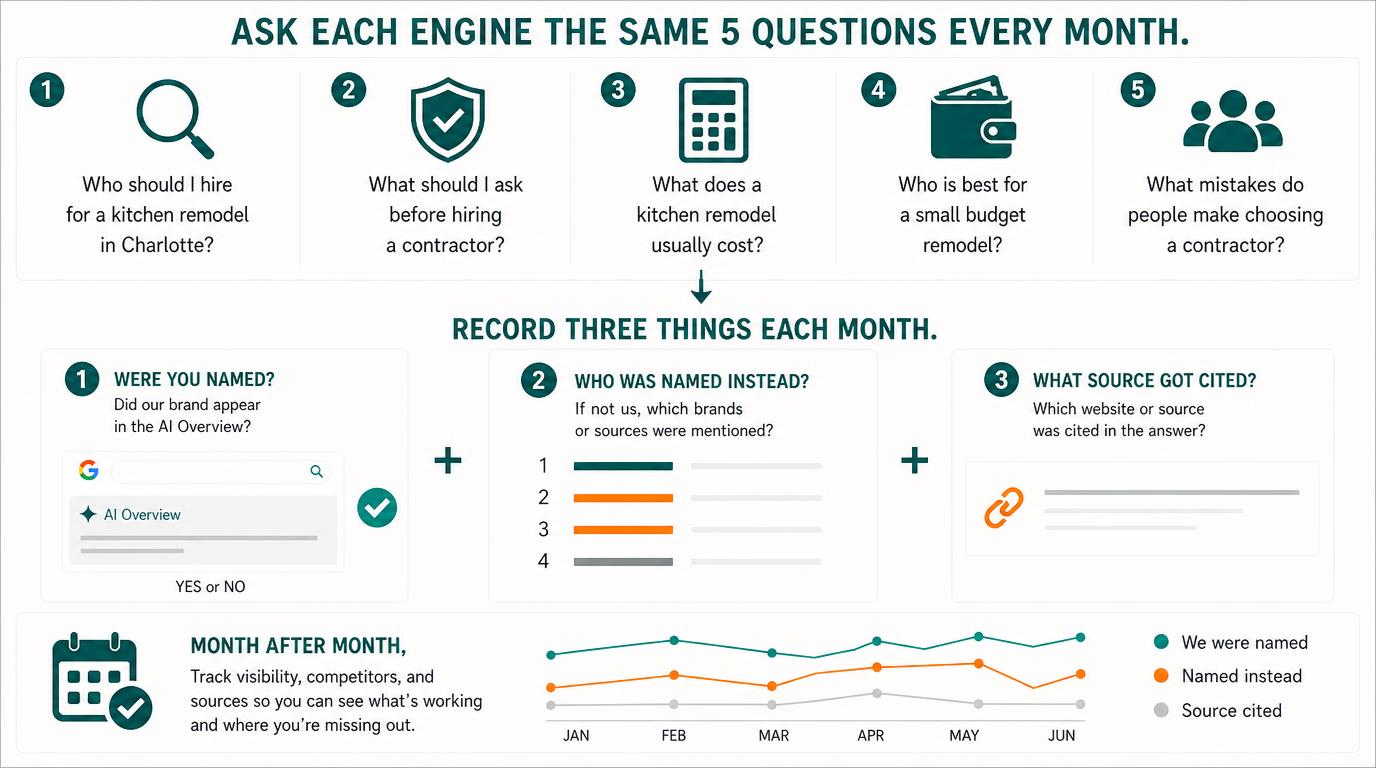
Nobody has a clean tool for this yet, so do it the manual way. Once a month, open ChatGPT, Google AI Mode, and Perplexity and ask the five questions your best customer would ask before hiring someone like you. Write down who gets named.
That list is your real competitive set now. It is frequently not the same list as the businesses ranking above you in Google.
You don’t need a tool. You need fifteen minutes a month and a document.
Ask each engine the same five questions every time, using the words a customer would use, not your industry’s words. Keep the wording identical month to month or you’re measuring your own phrasing instead of your progress.
I'm looking for [what you sell] in [your area]. Who should I be looking at
and why?

What should I ask before I hire someone for [the thing you do]?

What does [the thing you sell] usually cost, and what makes the price
go up or down?

Who's the best option for [your specific type of customer]?

What are the most common mistakes people make when choosing [your category]?
Run those in ChatGPT, Google AI Mode, and Perplexity. Record three things: whether you were named, who was named instead, and what source got cited.
That third one is the actionable one. If the same review site keeps getting cited, that’s where your next hour goes.
A few things to watch for
Anyone selling you guaranteed AI rankings is selling you something that does not exist. There is no submission form, no placement to buy, and no verified way to force a citation. The mechanics are inference over a shifting index.
This moves fast and unevenly. Percentages in this guide were accurate when it was written and the direction matters more than the decimals. Recheck anything you plan to say out loud.
Being cited is not always a visit. Sometimes you get named with no link at all, which still builds recognition but will not show in your analytics. Judge this by whether people mention finding you through AI, not only by traffic.
Your website still matters, it just isn’t the whole strategy. Vendor sites are 14.7% of citations. That’s a real slice and it’s the one you fully control. Do not read “your site is a minority shareholder” as “neglect your site.”
The takeaway
The clicks aren’t coming back, and that’s the hard part to sit with. But the thing underneath the clicks never changed. People still need to figure out who to trust before they spend money, and they’re still doing that by reading what already exists about you.
The only thing that moved is where that reading happens.
So write the answers down where they can be found. Say the price. Answer the question in the first paragraph instead of the ninth. Be useful in the places your customers already gather. Label your business so a machine can read it.
None of that is a trick and none of it expires the next time an algorithm changes. You’re not trying to rank anymore. You’re trying to be the answer, and being the answer mostly means having actually written one.
Sources
- SparkToro and Similarweb, US zero-click search study, January to April 2026
- Alphabet, AI Overviews monthly active users, Sundar Pichai
- Search Engine Journal, click-through rates with and without AI summaries
- 2026 GEO citation studies across ChatGPT, Perplexity, Google AI Mode, and Claude, including the 1M+ data point Otterly AI citation report and the 120K-citation source-affinity study
- Google Search Central, 2026 guidance on AI search
- Structured data citation rates, Google AI Mode and ChatGPT, 2026
Want more like this?
One simple AI win in your inbox every Sunday. No jargon, no overwhelm, unsubscribe whenever you like.
Want more like this?
Free AI guides added regularly. No jargon, no overwhelm.
kellystrattonai.com